
You swing your legs out of bed and put your foot down, and it feels as though someone has left a drawing pin in your heel. You hobble to the kettle. After a few minutes it eases, and you forget about it, until you stand up after lunch and it comes roaring back.
If that sounds familiar, you have probably met plantar fasciitis: one of the most common causes of heel pain, and one of the most frustrating. This guide explains what is happening in your foot, what genuinely helps (much of it is unglamorous), where a scan fits, and where a guided injection makes sense, and where it does not.
| The short version• Plantar fasciitis affects around one in ten people at some point, most often in their 40s and 50s.• Most people improve with stretching, sensible footwear and time. “Time” can mean months, which is why it feels so stubborn.• A steroid injection can give a window of relief so that rehabilitation becomes possible. It is not a cure, and it is not the first step for most people.• If an injection is used, precision matters. Ours are guided by live ultrasound. |
What is the plantar fascia, and why does it hurt?
The plantar fascia is a thick, fibrous band that runs from your heel bone to the base of your toes. It supports the arch of your foot and acts like a spring with every step. When it is overloaded, the point where it attaches to the heel becomes painful.
Despite the name, long-standing cases involve more than inflammation. There can be tiny tears and disorganised fibres in the tissue as well. Common contributors include a sudden increase in walking or running, long hours on hard floors, tight calf muscles, unsupportive footwear and carrying extra weight.
The classic pattern
• Sharp pain at the inner, front part of the heel.
• Worst with the first steps in the morning, or after sitting for a while.
• Eases as you move about, but may return after a long day on your feet.
• Worse when barefoot on hard floors, on stairs, or on tiptoe.
What genuinely helps first
The evidence is consistent that a structured routine of stretching and strengthening, supportive footwear and sensible load management is the foundation of treatment. It is not quick, but it works for many people.
• Stretch daily. Calf stretches and plantar fascia stretches, done consistently.
• Support your feet. Cushioned, supportive shoes, even indoors. Avoid going barefoot on hard floors.
• Cut back, do not stop. Reduce the activity that flares the pain and build back gradually.
• Consider heel cushions, orthotics or a night splint if a clinician recommends them.
• Give it a fair trial. Several weeks of genuine consistency, not two half-hearted days.
Is it definitely the plantar fascia?
Not every heel pain is plantar fasciitis, and treating the wrong problem wastes time. This is a rough guide to the patterns:
| Where and how it hurts | What it may point to | Worth knowing |
| Inner, front part of the heel. Worst on the first steps of the day. | Plantar fasciitis | The subject of this article. |
| Back of the heel. Stiff in the morning, worse after running. | Achilles tendinopathy | A different tendon needing a different plan. See our Achilles injection. |
| Burning, tingling or pins and needles in the ball of the foot or toes. | Morton’s neuroma or nerve irritation | A nerve problem. See our Morton’s neuroma treatment. |
| Deep, aching heel pain that builds with impact and may ache at night. | Possible stress fracture | Needs prompt assessment, and an MRI may be the better scan. |
Heel pain with swelling, redness, warmth, fever, numbness, a recent injury or an inability to put weight on the foot should be assessed promptly. If you have diabetes and any foot problem, please do not wait.
Where an ultrasound scan fits
Heel pain is often diagnosed from your history and an examination. A scan earns its place when the picture is unclear or the pain is not improving. An ultrasound of the foot and ankle can show thickening and changes in the plantar fascia, check for a tear, and help rule out other causes. It is also how an injection is placed accurately.
Ultrasound cannot see everything. If a stress fracture is suspected, an MRI may be needed. A foot and ankle scan at Acorn is £260, all-inclusive, with results explained at your appointment.
Where a guided injection fits, and where it does not
An injection should not be the first thing you try. But there are good reasons to consider one:
• The pain is so severe that you cannot do the rehabilitation that would help.
• Several weeks of consistent self-care have not moved it, and the pain is stopping you working, sleeping or living normally.
What the evidence says
Steroid injections tend to give faster relief than other treatments in the short term, but the advantage often fades over the following months, and on their own they do not repair the tissue. A randomised trial published in 2018 found the best results came from combining a steroid injection with a structured programme of strength training and stretching. That is exactly how we like to use an injection: as a bridge, not a destination.
The risks worth knowing
Common effects are temporary soreness and, occasionally, a short-lived flare of pain. Rarer but real risks include thinning of the heel’s natural fat pad, lightening of the skin and, uncommonly, weakening or rupture of the fascia. That is why the dose, the technique and how often it is repeated all matter. As a general rule, we advise no more than three steroid injections per joint per year, with at least three months between them, and repeated heel injections are approached with particular care.
How we do it at Acorn
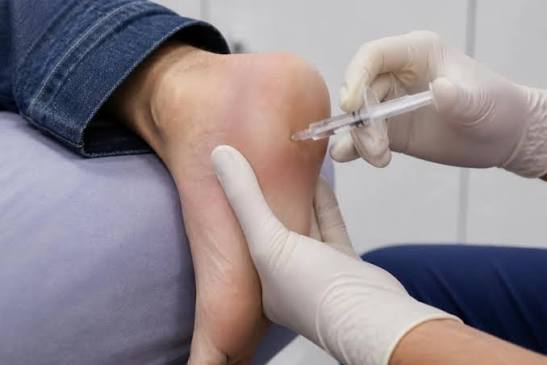
Your injection is performed by a consultant radiologist under live ultrasound guidance. We watch the needle from skin to target, so the steroid goes to the fascia itself rather than to “roughly the right area”. The heel is a sensitive place, so we pair the injection with an ankle block: local anaesthetic around the nerves at the ankle, which numbs the foot first and keeps the procedure comfortable.
Some people notice an improvement within one to two weeks, although how long the relief lasts varies from person to person. A plantar fascia injection is £399, all-inclusive, covering the consultation, scan guidance, injection, written report and aftercare advice.
We will also tell you honestly if an injection is not the right answer. If your consultant decides that physiotherapy, footwear changes or another approach is the smarter first move, you will only pay the consultation fee (£120) instead of the injection price, and if you book an injection the same day the consultation fee is credited against it. Our injection therapy page explains the wider range of options, and our article on how ultrasound-guided injections work goes into the technique. Not every injection works for every person, and if you do not get enough relief we will talk through the alternatives with you.
After the injection: the first few days
• Soreness at the injection site for a day or two is common.
• Take it easy. Gentle walking is fine, but avoid hard exercise for the first few days, and follow the aftercare advice you are given.
• Restart your stretches when it is comfortable. This is what helps the relief last.
• A flare of pain in the first 24 to 48 hours happens in a small number of people and settles on its own.
• Contact us promptly if you notice increasing redness, heat, swelling, fever or spreading pain.
• If you have diabetes, tell us beforehand, as steroids can temporarily raise blood sugar.
Frequently asked questions
Do I need a referral, and how quickly can I be seen?
For most injections at Acorn, no referral is needed, and you can book directly online or by phone. Most appointments are available within 48 hours, and if a diagnostic scan finds something treatable we can usually inject in the same visit.
Is it covered by private medical insurance?
We accept most major UK insurers for injection therapy, including Bupa, AXA Health, WPA and Vitality. See our insurance page for help with pre-authorisation.
| Ready to get your first steps back?Book an injection: Book online Not sure yet? Book a £120 consultation Call: 029 2199 9300Visit: 13 Washington Buildings, Stanwell Road, Penarth CF64 2ADSee all prices or get in touch. |