
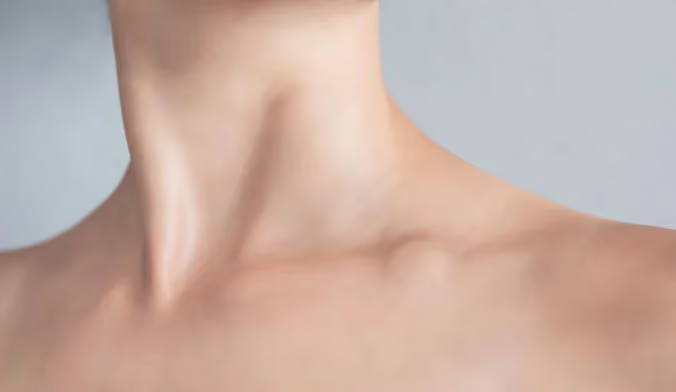
It is usually found by accident. In the bathroom mirror. In a shirt collar that suddenly feels tight. Under the hairdresser’s comb, or by a friend who says, “What’s that on your neck?”
Then the internet does what it does best: it offers you the worst-case scenario in under a second. So let us start with the calmer truth. Thyroid nodules are very common, and the great majority are benign. But “most” is not “all”, and that gap is exactly why a scan is worth having rather than a long, anxious wait.
This guide explains what your thyroid does, which symptoms are worth checking, what a thyroid ultrasound actually looks at, how nodules are scored, and what to expect at an appointment at Acorn Private Clinic in Penarth.
| The short version• Ultrasound shows the structure of your thyroid. Blood tests show how it is working. You often need both.• Nodules are common and most are benign. Each one is measured and scored, so you know whether anything more is needed.• The scan takes around 20 to 30 minutes, uses no radiation and needs no preparation. |
First, what is the thyroid, and why does it matter?
Your thyroid is a small, butterfly-shaped gland at the front of your neck, just below the voice box. It makes hormones that help set the pace of your metabolism, which is why an underactive or overactive thyroid can affect energy, weight, mood, heart rate and how warm or cold you feel. Because it sits so close to the skin, it is unusually easy to see with ultrasound.
Signs that are worth getting checked
• A lump or swelling at the front of the neck, which may be painless.
• A feeling of fullness, or a collar that suddenly feels tight.
• Difficulty swallowing, or a sensation of something stuck in your throat.
• A hoarse voice that does not clear up.
• Abnormal thyroid blood tests (TSH or T4).
• A nodule that was picked up incidentally on another scan.
• A family history of thyroid disease or thyroid cancer.
| Some symptoms need prompt attention, not a routine scanA lump that is growing quickly, noisy breathing, or difficulty breathing or swallowing should be assessed urgently. Contact your GP straight away or call NHS 111. If you are struggling to breathe, call 999. |
What a thyroid ultrasound looks at
Ultrasound uses sound waves rather than radiation, so it is safe in pregnancy and can be repeated as often as needed. At Acorn, your scan is performed by a consultant radiologist, who examines:
• Both lobes and the isthmus (the bridge between them), including size and volume.
• Every nodule: how many there are, how big each one is and where it sits.
• What each nodule is made of: solid, fluid-filled or a mixture of both.
• The background texture of the gland, which can change in autoimmune conditions such as Hashimoto’s thyroiditis.
• Calcification, because coarse and fine calcification carry different significance.
• The lymph nodes in the neck around the thyroid.
What it cannot tell you
Ultrasound cannot tell you whether your thyroid is overactive or underactive. Only blood tests can do that. It also cannot give a definitive answer about cancer, because only a biopsy can. What it can do is show which nodules look reassuring and which deserve a closer look.
How nodules are scored: the U1 to U5 scale
In the UK, thyroid nodules are graded using the British Thyroid Association’s ultrasound scale. Each nodule is assessed for features such as its make-up, outline, shape, how bright it appears on the scan, and any calcification.
| Score | What it means | What usually happens next |
| U1 | A normal thyroid with no nodule. | No further imaging is usually needed for the scan findings. |
| U2 | A nodule with benign-looking features. | Usually no biopsy. It may be monitored, depending on your circumstances. |
| U3 | Indeterminate. The features are neither clearly reassuring nor clearly worrying. | Further assessment, which may be a repeat scan or a biopsy, depending on size and your clinical picture. |
| U4 | Suspicious features. | Biopsy and referral to a specialist team. |
| U5 | Features suggesting malignancy. | Biopsy and referral to a specialist team. |
The score is combined with the size of the nodule and your own history, so two people with the same score can have different plans. Your consultant will explain exactly what applies to you, and why.
Your appointment, step by step
1. Arrive. Our Penarth clinic is a five-minute walk from Penarth railway station, and there is free street parking nearby.
2. Talk it through. Your consultant looks at your history and any blood results, and asks what prompted the scan.
3. The scan. You lie on your back with a pillow under your shoulders so that your neck is gently extended. Warm gel goes on the front of your neck, and you may be asked to swallow, which helps separate the thyroid from the structures around it. It takes about 20 to 30 minutes.
4. Your results. Findings are explained as you go and again at the end, including what each nodule scored and whether anything further is needed. A written report and your scan images follow within 24 to 48 hours.
How to prepare
• Wear an open-neck top and remove any necklaces.
• Eat, drink and take your medication as normal, including thyroid tablets. No fasting is needed.
• Bring recent blood results and any previous scan reports. Comparing scans is how we can tell whether a nodule has changed, and it is often the most useful thing you can do.
Thyroid scan, neck scan or blood tests?
The right test depends on where the concern is:
• Choose the thyroid scan if your concern is the gland itself: a swelling at the front of the neck, a nodule, an abnormal blood test, or a nodule you are already monitoring.
• Choose the neck scan for lumps elsewhere in the neck, swollen glands or a salivary gland problem.
• Add blood tests to check how the thyroid is working. TSH and T4 can be run alongside your scan and read together.
A single scan area is £260, two areas in one appointment (for example, thyroid plus the rest of the neck) is £360, and three areas is £399. If you are not sure which to book, call us and we will help you choose. If you book the wrong one, the consultant simply scans whatever is relevant on the day.
What if a nodule needs a closer look?
Most people never need a biopsy. If a nodule does need sampling, the usual test is a fine-needle aspiration, where a thin needle collects a few cells for laboratory analysis. We arrange this with a specialist, and your report sets out exactly which nodule needs sampling and why, so that nothing is repeated unnecessarily.
If you already have a nodule that is being watched, bring your previous reports. Direct comparison is the whole point of monitoring.
Frequently asked questions
Does a thyroid nodule mean I have cancer?
Almost certainly not. Nodules are common, particularly in women and as we get older, and the great majority are benign. Ultrasound identifies the features that raise or lower suspicion. A definitive answer needs a biopsy, and most people never need one.
Do I need a GP referral?
No. Adult ultrasound scans at Acorn are self-referral, so you can book directly. Read more in our guide to self-referral ultrasound.
Does the scan hurt?
No. The gel is warm, and the only sensation is a little pressure from the probe. You may be asked to swallow a few times.
How quickly can I be seen?
Most appointments are available within 48 hours.
Can my GP or specialist see the report?
Yes. With your permission, we can send the report to your GP or endocrinologist.
Is it covered by private medical insurance?
We are recognised by most major UK insurers, but each has its own rules about pre-authorisation, so please check before your appointment. See our insurance page for details.
| Ready for answers?Book a thyroid scan (£260): Book onlineCall: 029 2199 9300Visit: 13 Washington Buildings, Stanwell Road, Penarth CF64 2AD. Open Monday to Thursday 9am to 6pm, Friday 9am to 5pm and Saturday 9am to 3pm.Browse all our private ultrasound scans or meet our consultants. |